Mr Cavor + Cavorite
Cavorite was the original spark: the idea that humans might escape the gravitational conditions that had always defined life on Earth. That anti-gravity imagination became part of Cavorion’s earliest identity.
Cavorion did not begin with rockets. It began with astronomy, celestial reference points, meridians, and the question of how humans orient themselves in relation to time, the sky, and the environments still to come.
The name Cavorion began with H. G. Wells’ The First Men in the Moon. In the story, Mr Cavor creates Cavorite — a fictional substance that overcomes the ordinary pull of gravity and makes a journey to the Moon possible.
Cavorite was the original spark: the idea that humans might escape the gravitational conditions that had always defined life on Earth. That anti-gravity imagination became part of Cavorion’s earliest identity.
As Cavorion grew, the name acquired a second internal meaning: cavo as rope or anchor, and Orion as the stars — an anchor to the stars. It reflects Cavorion’s larger purpose: maintaining human reference and continuity while reaching outward.
Cavorion is now much more than its literary starting point. It has expanded into time, navigation, identity, human continuity, communication, travel, governance and frontier systems. Yet the original theme remains: humanity is becoming increasingly anti-gravity — learning to live, work and move in environments where gravity is no longer the unquestioned condition around which human life is organised.
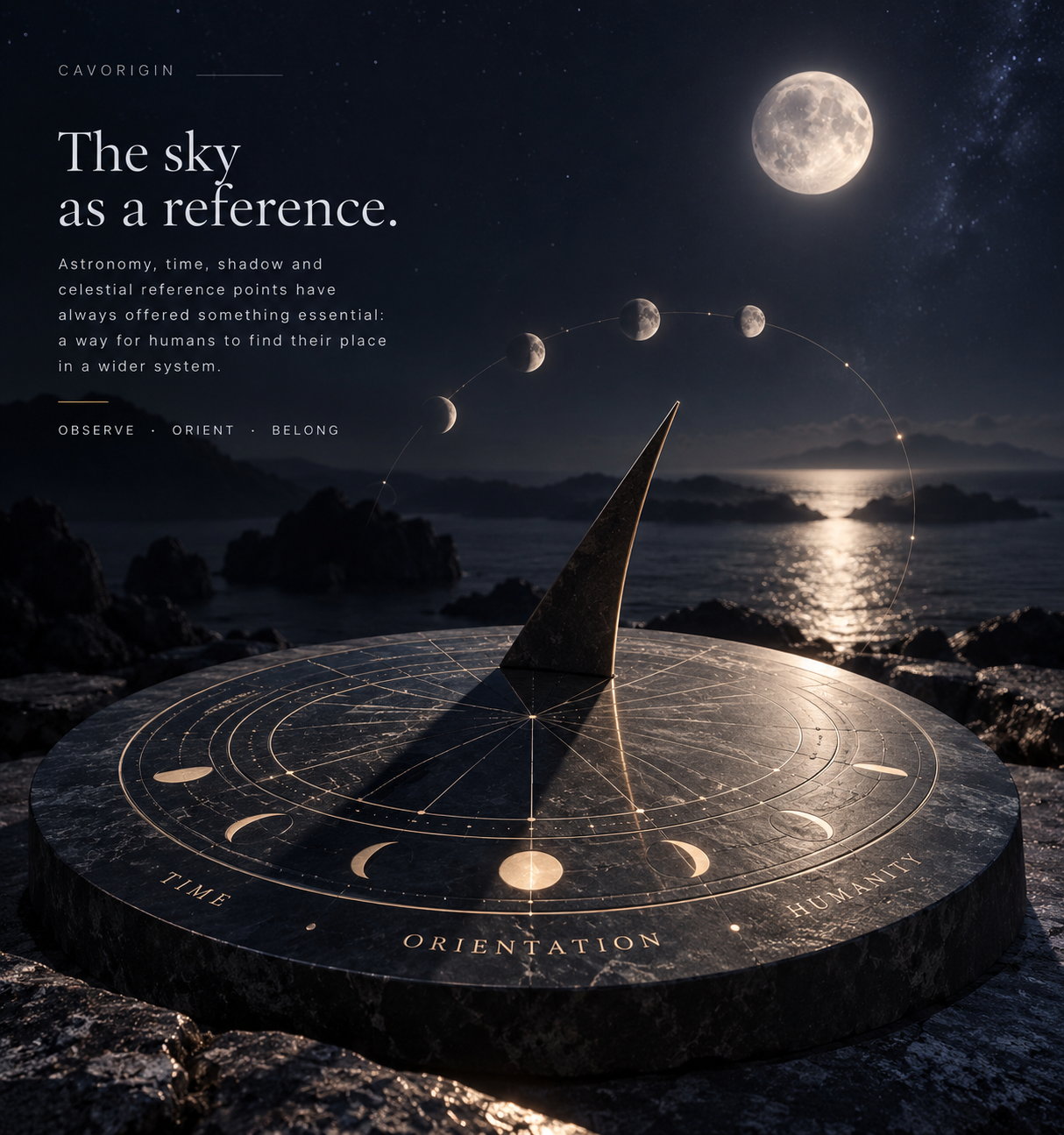
One of the deepest influences behind Cavorion was not industrial aerospace, but a quieter, older atmosphere: astronomical time, shadow, observatories, ancient stones, sidereal rhythms, and the search for meaning through orientation. The early insight was simple: time could be observed, referenced, and used as part of how humans understand where they are.
The sky was not only beautiful; it functioned as a map, a clock, and a system of reference.
Navigation, coordination, and human coherence all return to time. This became one of the core realisations behind Cavorion.
Over time, it became clear that Cavorion was not fundamentally about launch vehicles or conventional aerospace hardware. It was about how humans orient themselves in environments where familiar cues begin to disappear. Space is one of the clearest environments in which this becomes urgent — but the deeper foundation is time, orientation, and the systems needed to help humans remain coherent across distance, delay, and complexity.
Sidereal, mission, biological, and civil time all shape how humans coordinate and navigate.
Beyond coordinates, humans need systems that help them locate themselves meaningfully in relation to Earth, sky, and mission.
Isolation, delay, autonomy, and extreme environments require human-centred design, not only engineering.
Cavorion did not emerge as a finished architecture. It developed by following a sequence of questions — first about time, then about humans, then about orientation, navigation, continuity, and the environments in which those questions become most demanding.
Cavigation studies navigation, orientation, and time across spacecraft, aerospace, autonomous systems, and other advanced environments.
Cavoriongevity extends the human question into health, adaptation, healthy ageing, space medicine, astronaut wellness, pharmaceuticals, and long-duration human continuity.
Cavorion Night translates the human-centred origin into a deliberately simple public experience built around identity, connection, reflection, and one shared planet.
Cavoyage connects Earth-based preparation with the emerging age of human spaceflight — a practical bridge between the world we inhabit and the frontier ahead.
“Cavorion is one of the few future systems projects to begin with time and humans — and only then move toward engineering and space.”
CavoriginThis origin now shapes Cavorion Night, Cavoyage, Cavigation, Cavoriongevity, Governance, Frontier, and SoundLab. The architecture has grown, but the central idea has not changed: Cavorion is concerned with helping humans find reference, coherence, continuity, and direction as our environments become more complex.